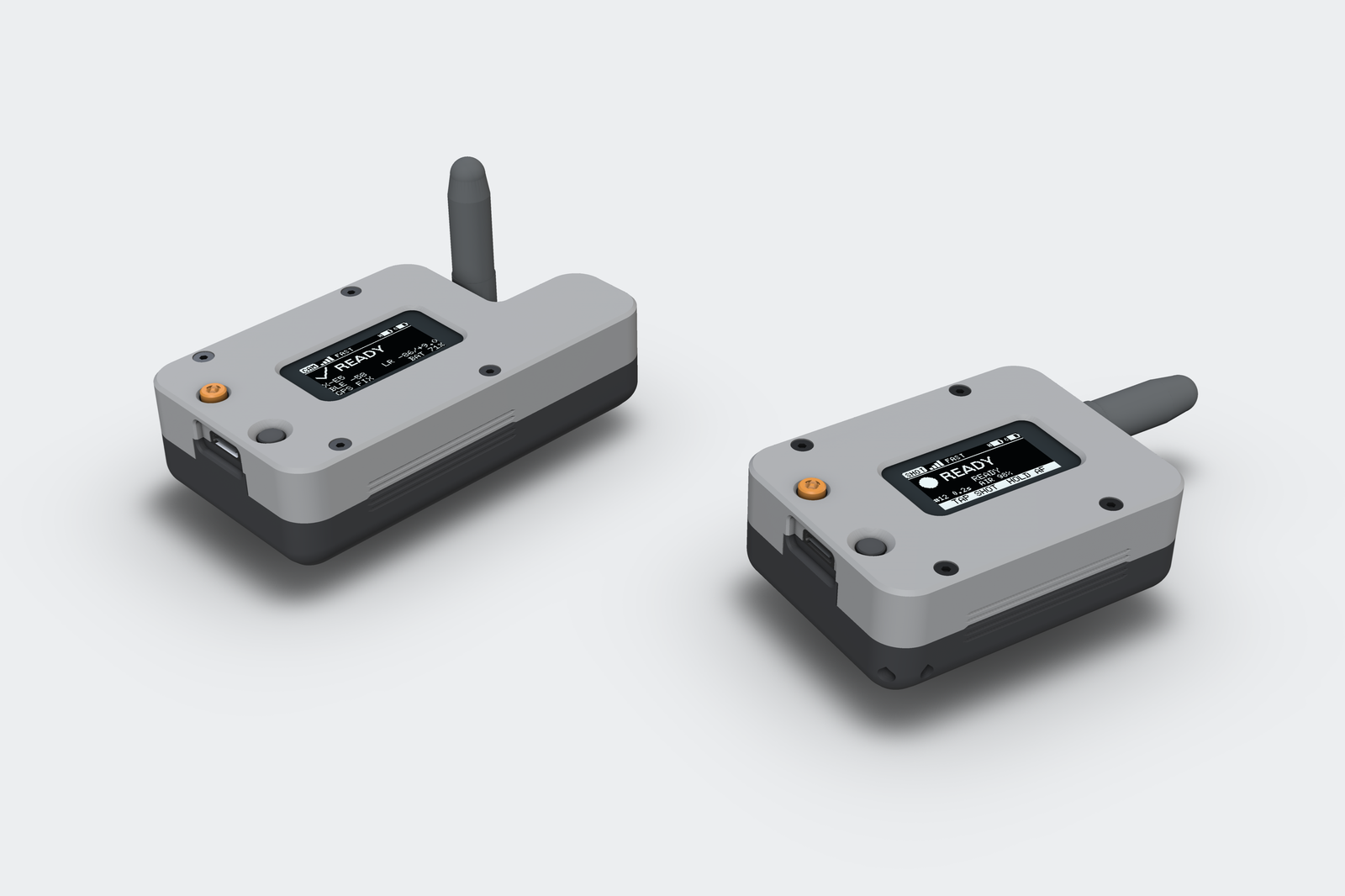
Super Long Range Remote
A camera remote unlike any other camera remote. One that works for miles.
For Fujifilm cameras. One button in your pocket, your camera on a tripod somewhere over there. Tap to shoot, hold to half-press and focus. The press travels by long range radio, so nothing plugs into the camera and your phone stays in your pocket.
Why I built it
I wanted to walk away from my camera and still take the picture
The camera's own Bluetooth remote reaches a few metres and needs a phone in your hand. I wanted something I could carry two fields away.
It keeps working long after Bluetooth has given up
Leave the camera on its tripod at the water's edge and walk round to the far bank. The shutter is still under your thumb.
The radio is LoRa, the one people use for links of several miles across open country, and the remote runs it at full strength for its band.
Nothing to unlock, launch or plug in
The handheld is one button and a small screen. The camera unit sits with the camera and presses the shutter through the camera's own Bluetooth remote release, so nothing plugs into the body.
Pull the remote out of a coat pocket with cold hands and press. If it was asleep, that same press wakes it and takes the photo.
The button behaves like a shutter button
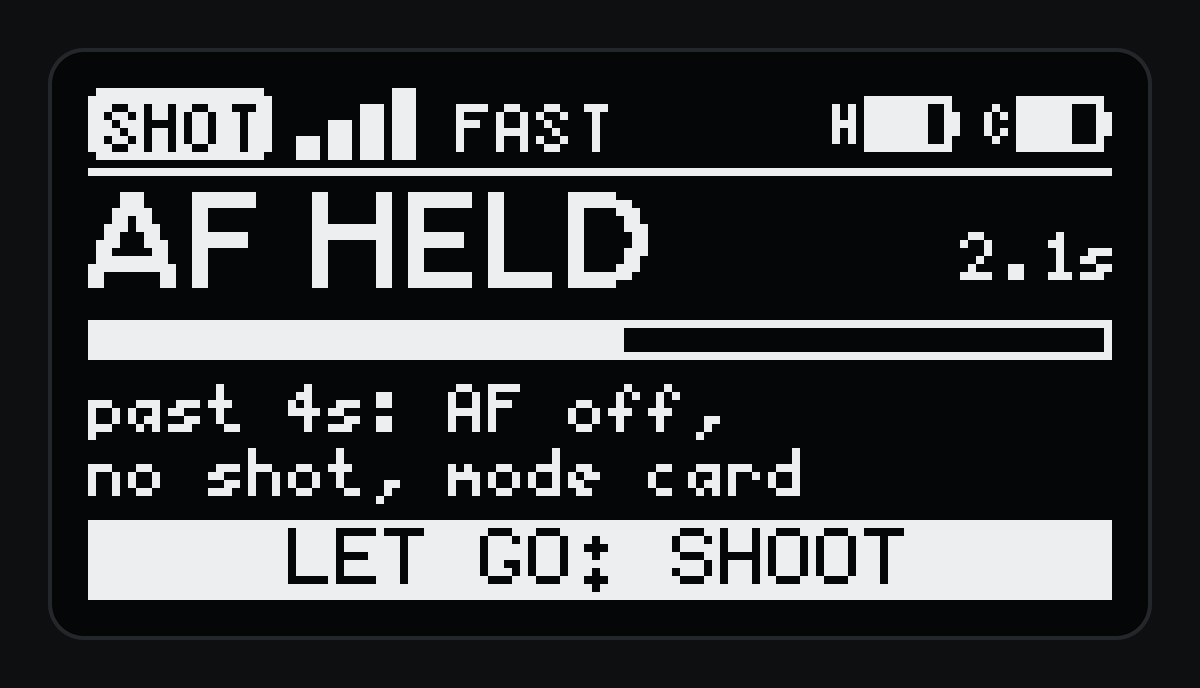
A tap is a shot. Hold it and the camera half-presses and holds focus until you let go, which fires.
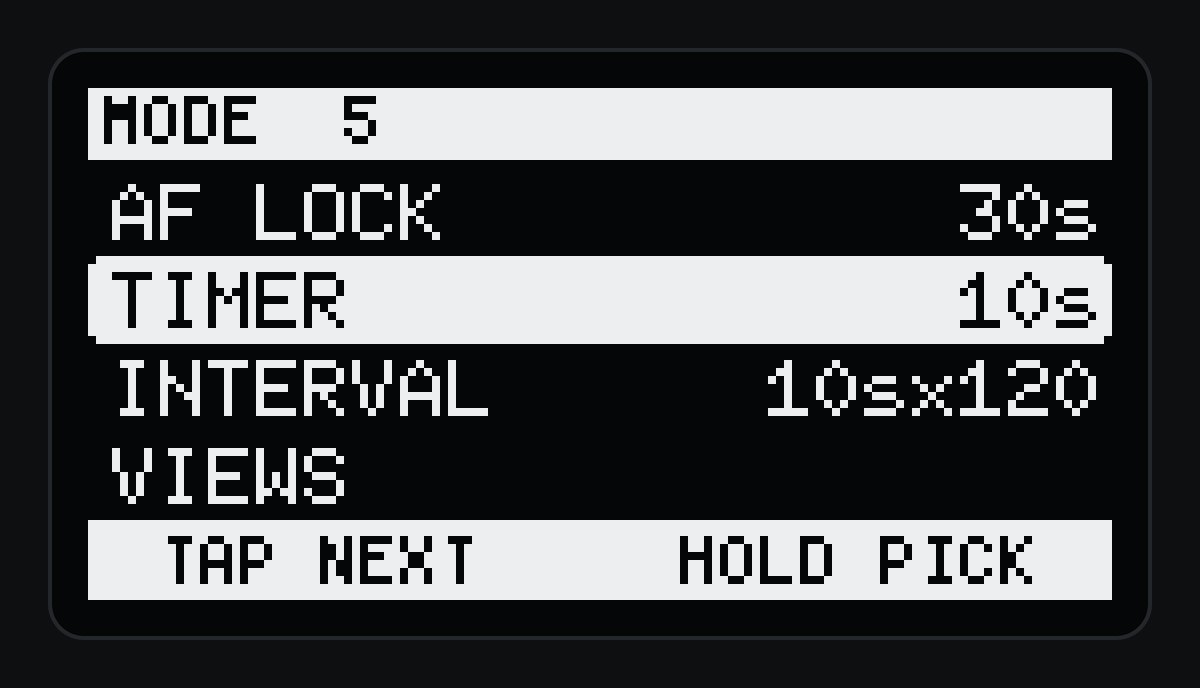
Keep holding and a mode card opens on the screen: self timer, focus lock and interval shooting are a tap away, and you can add burst, bulb and video to the list.
How it works
Two small radios, each doing the job it is good at
LoRa is a slow, patient radio system that carries small messages a very long way and through things that stop Bluetooth dead (here it runs on the 868 MHz band in the UK and EU, or the 915 MHz band in the United States). It takes your press across the distance. Bluetooth LE, the low-energy kind of Bluetooth, only has to cover the last hand's width from the camera unit to the camera.
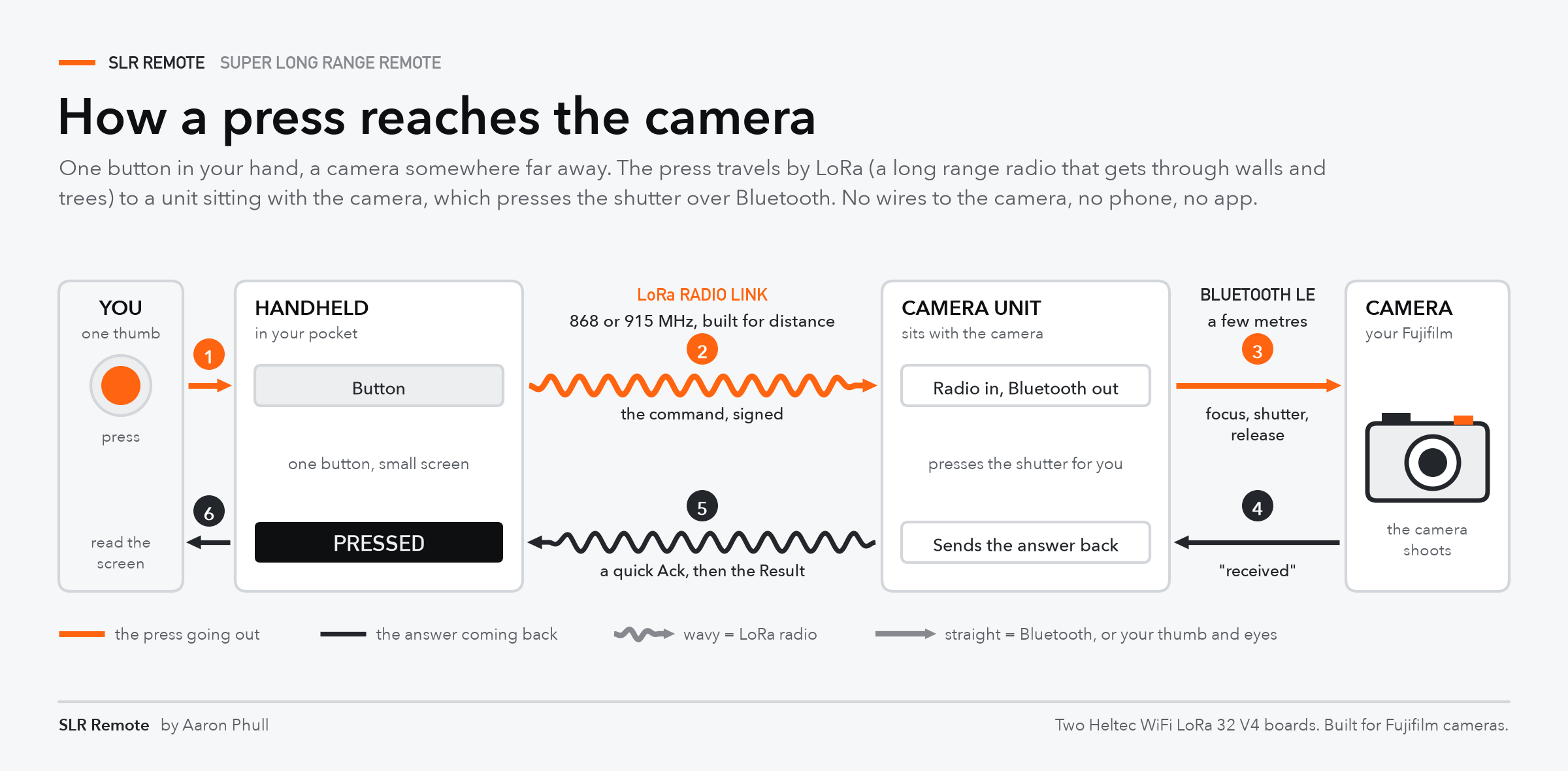
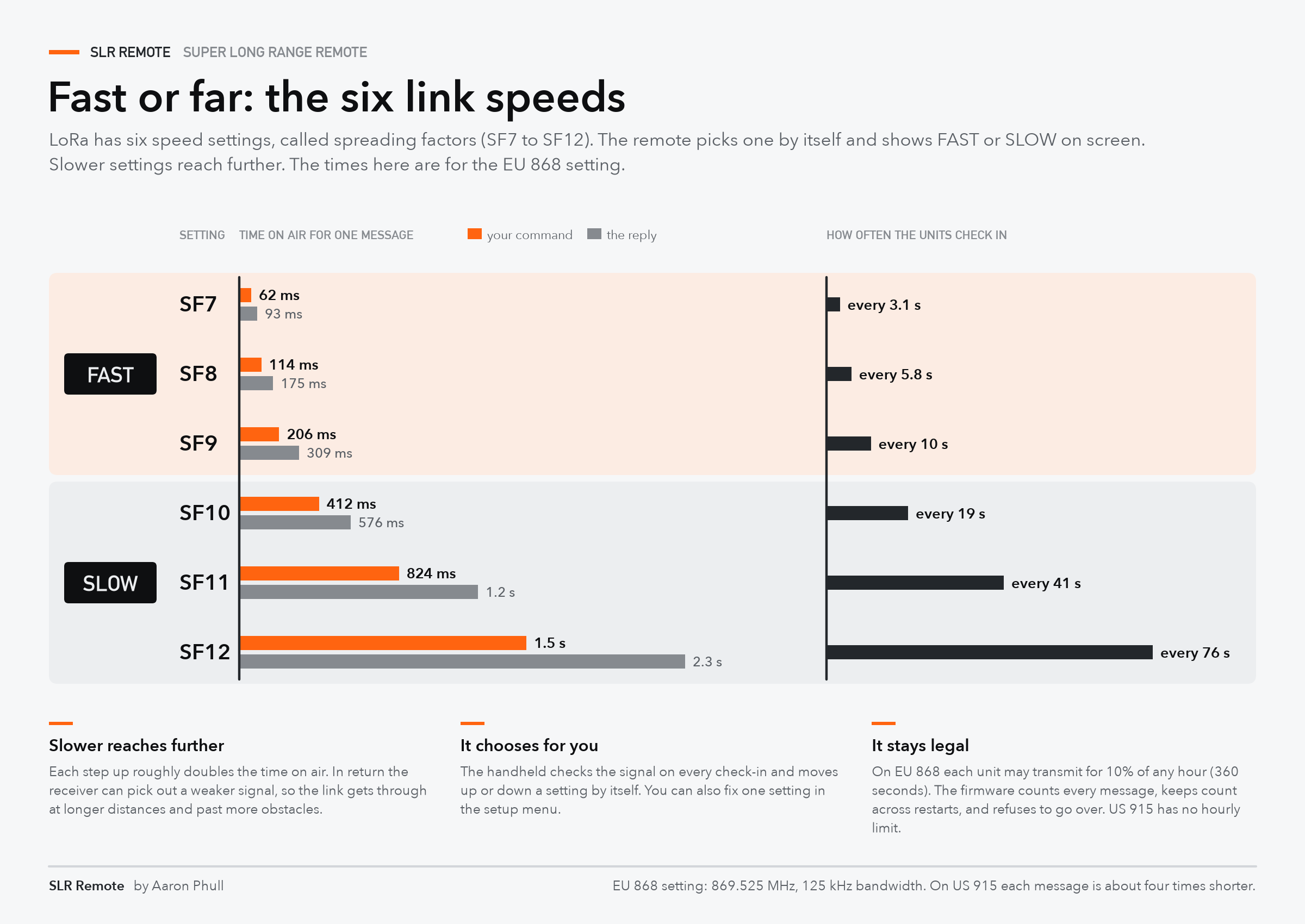
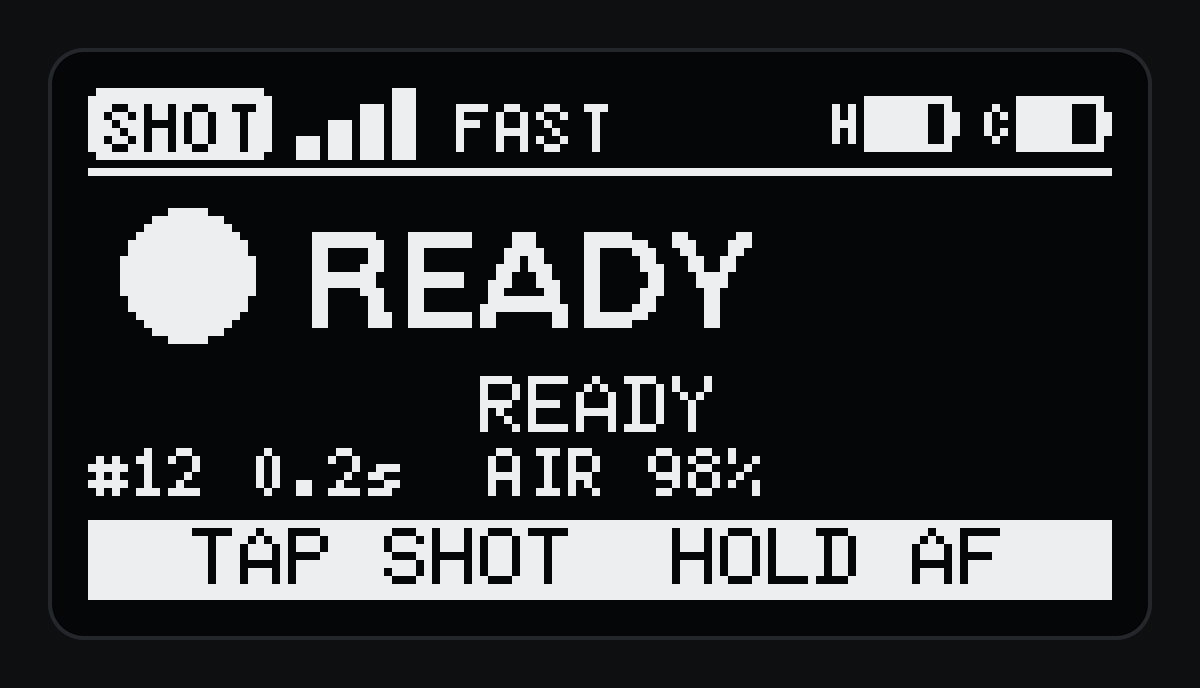
FAST or SLOW in the top bar. On the fast setting the camera unit has your press in about a fifth of a second.Want the radio detail? It is all in how it works.
Features
What it does
All of this works today, on my own X-E5.
Tap to shoot
One press does focus, shutter and release in the right order. The focus wait is adjustable for slower lenses.
Hold for half-press
Hold the button and the camera holds focus. Let go and it shoots. Change your mind, keep holding past four seconds, and focus drops with nothing fired.
Focus lock
Tap to lock focus for 10, 30 or 60 seconds, then tap again the instant the bird lands and it fires at once. No autofocus hunting at the moment that matters.
Self timer and interval
A countdown on the screen from 2 to 20 seconds. Or an interval run: a frame every 2 seconds to every minute, for a set count or until you stop it.
Burst and bulb
With one board talking Bluetooth straight to the camera (direct mode), hold the shutter down for a timed burst, or open it on bulb for anything from 30 seconds to 30 minutes with a clock counting on the screen.
Video
Switch the camera to movie mode and a press starts recording. Press again to stop.
Finds its own speed
The link measures how much signal it has in hand and shifts between FAST and SLOW by itself. Walk back towards the camera and it speeds up again.
A screen you can trust
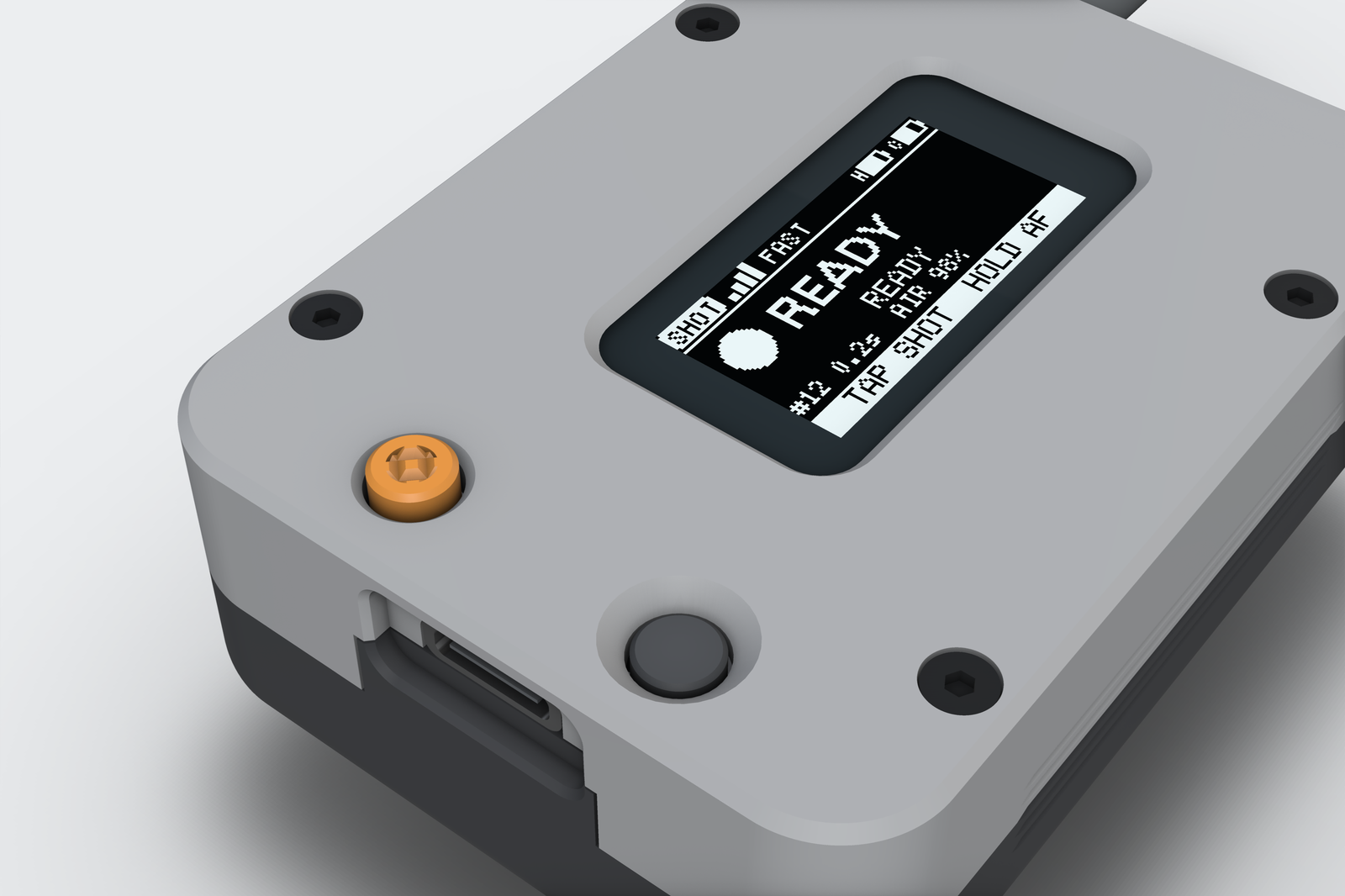
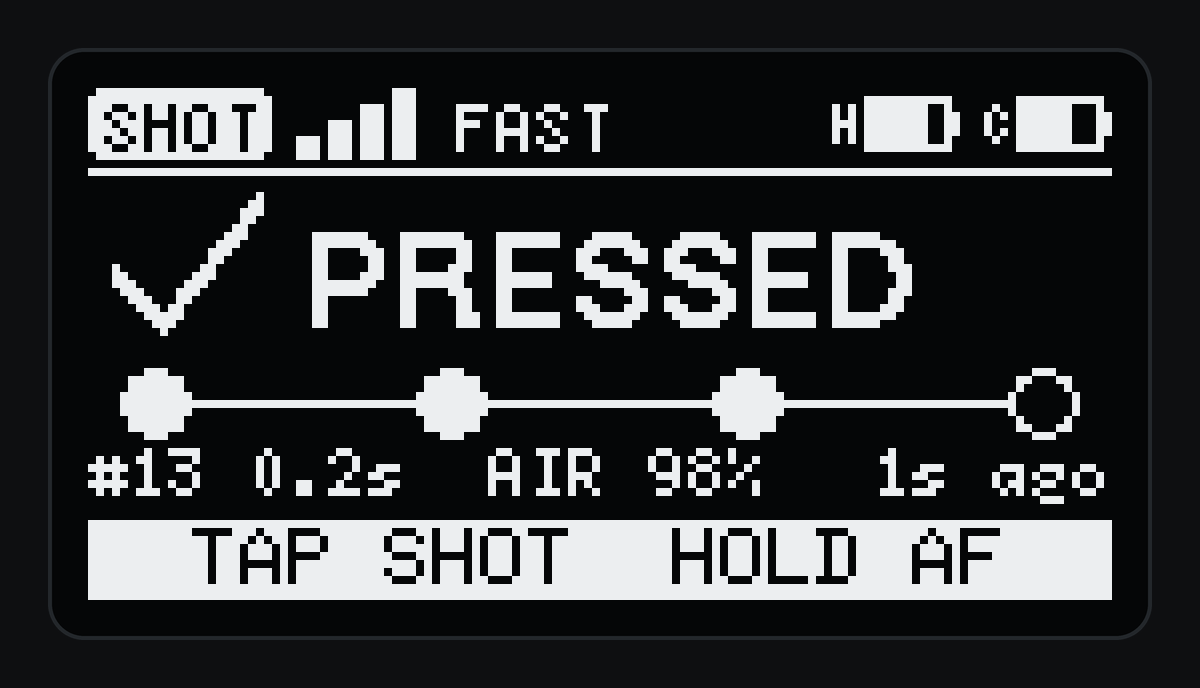
SENT, AT CAM, PRESSED: each word appears only when that step has really been confirmed. Signal bars and both batteries sit in the top bar.
Lets go by itself
If the handheld dies or drops out of reach while you are holding a press, the camera unit releases the shutter on its own. On the fast setting that took about ten seconds when I pulled the power.
Yours alone
The two units pair once, with a six-digit code you check on both screens. After that every message is signed and numbered, so nobody else's remote can fire your camera.
Legal on the air
Tell it where you are with the Region setting: EU 868 or US 915. On the UK and EU band, each transmitter is allowed 10% of any hour on air. The remote keeps its own count, stays inside it, and remembers the count through restarts. The US band has no such limit.
Tally light and GPS
Two optional extras: a small LED on the camera unit that lights when a shot fires, so the people in the picture can see it go, and GPS, which geotags your photos. Put a module in the handheld too and it shows how far away your camera is and which way to walk.
Every mode and every screen word is explained in the user guide.
Gallery
Small enough to forget it is in your pocket
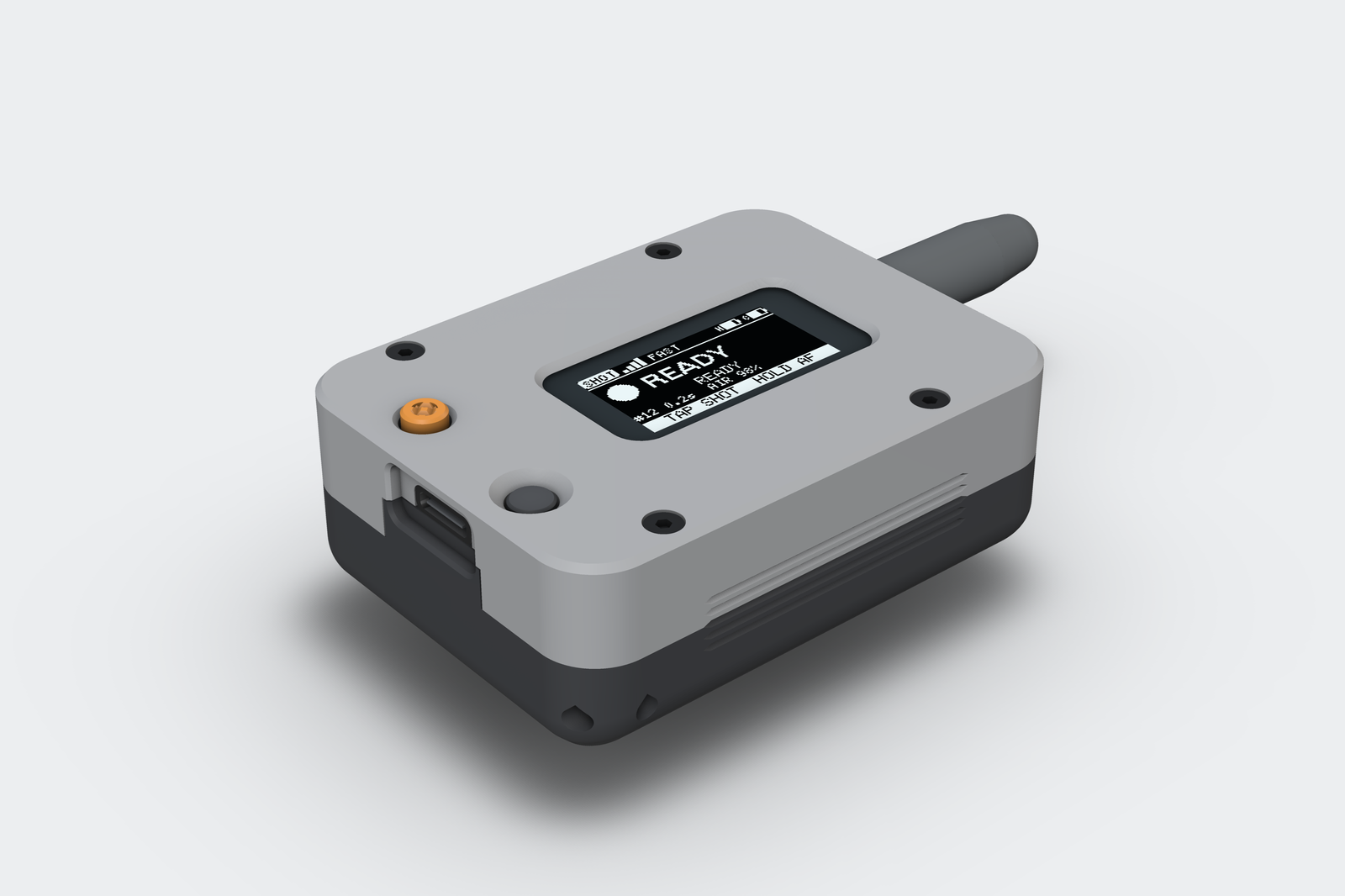
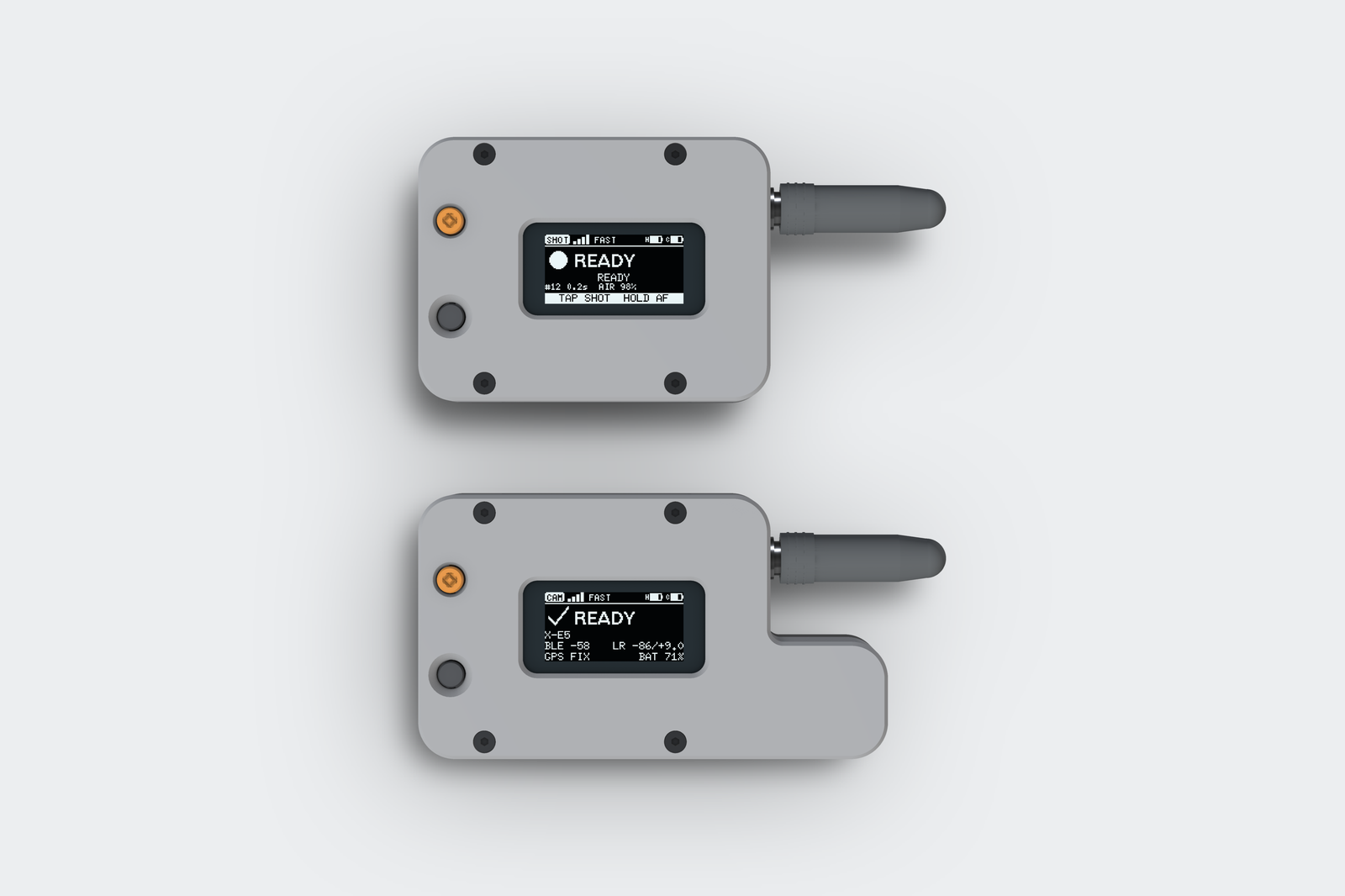
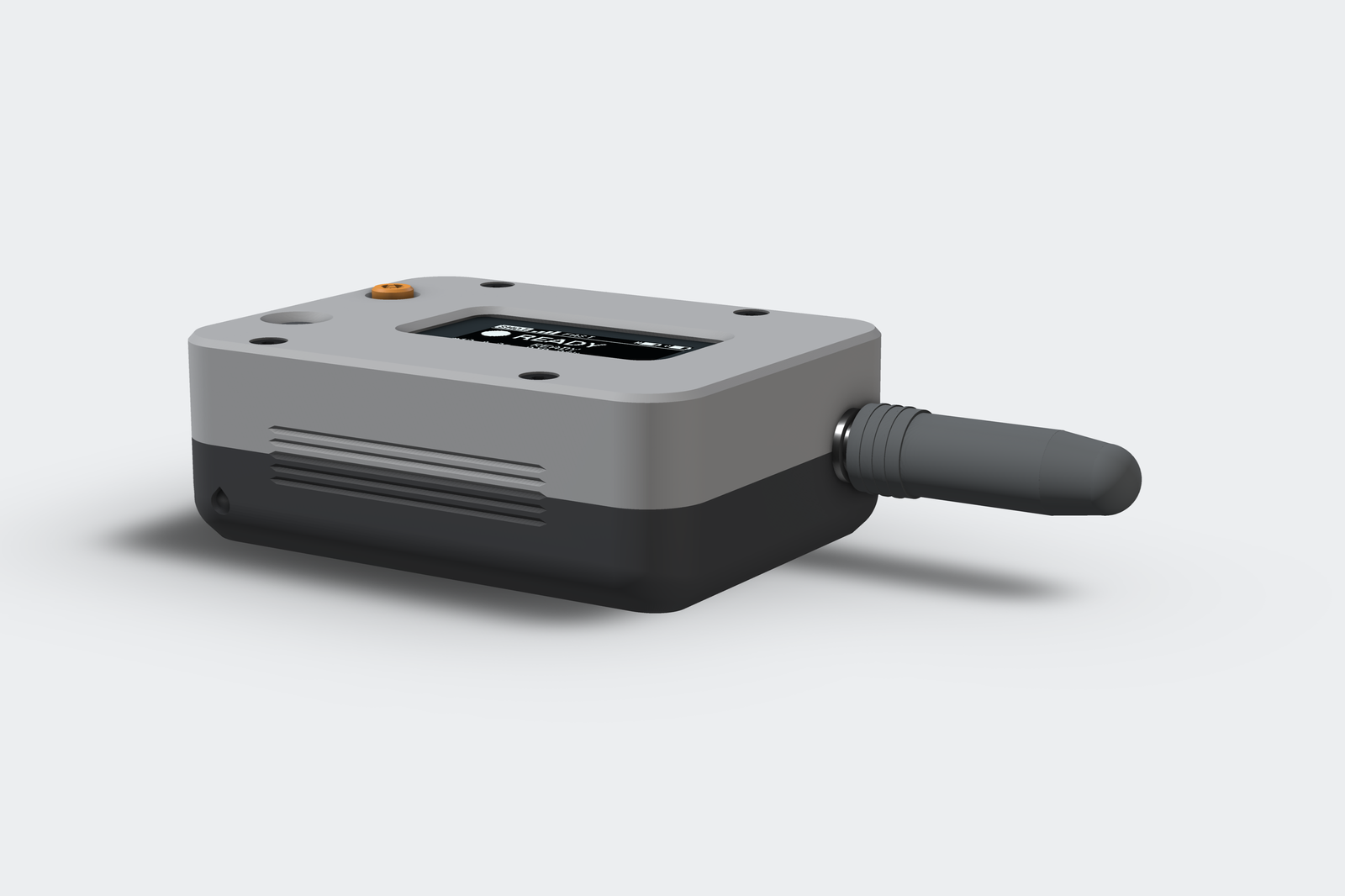
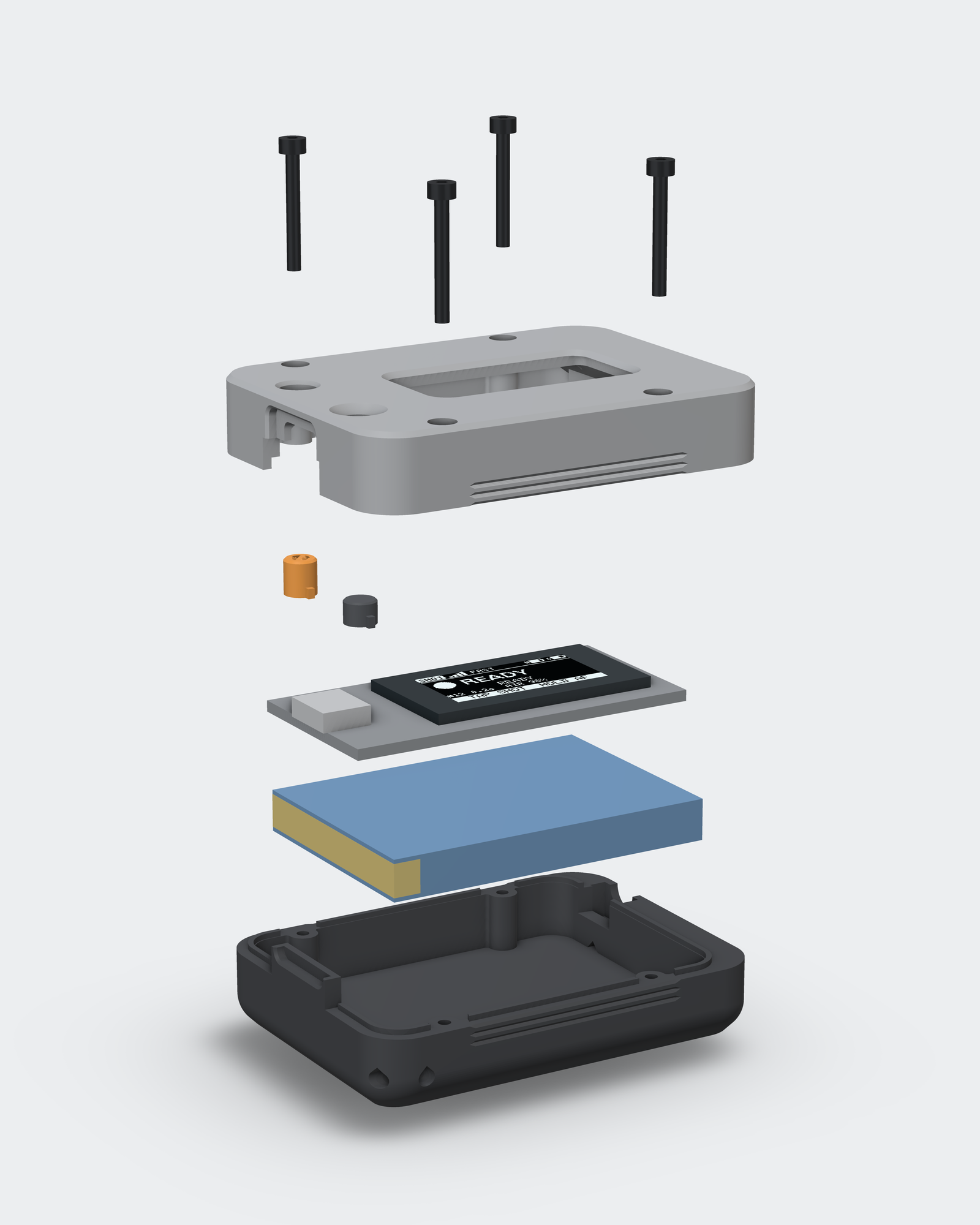
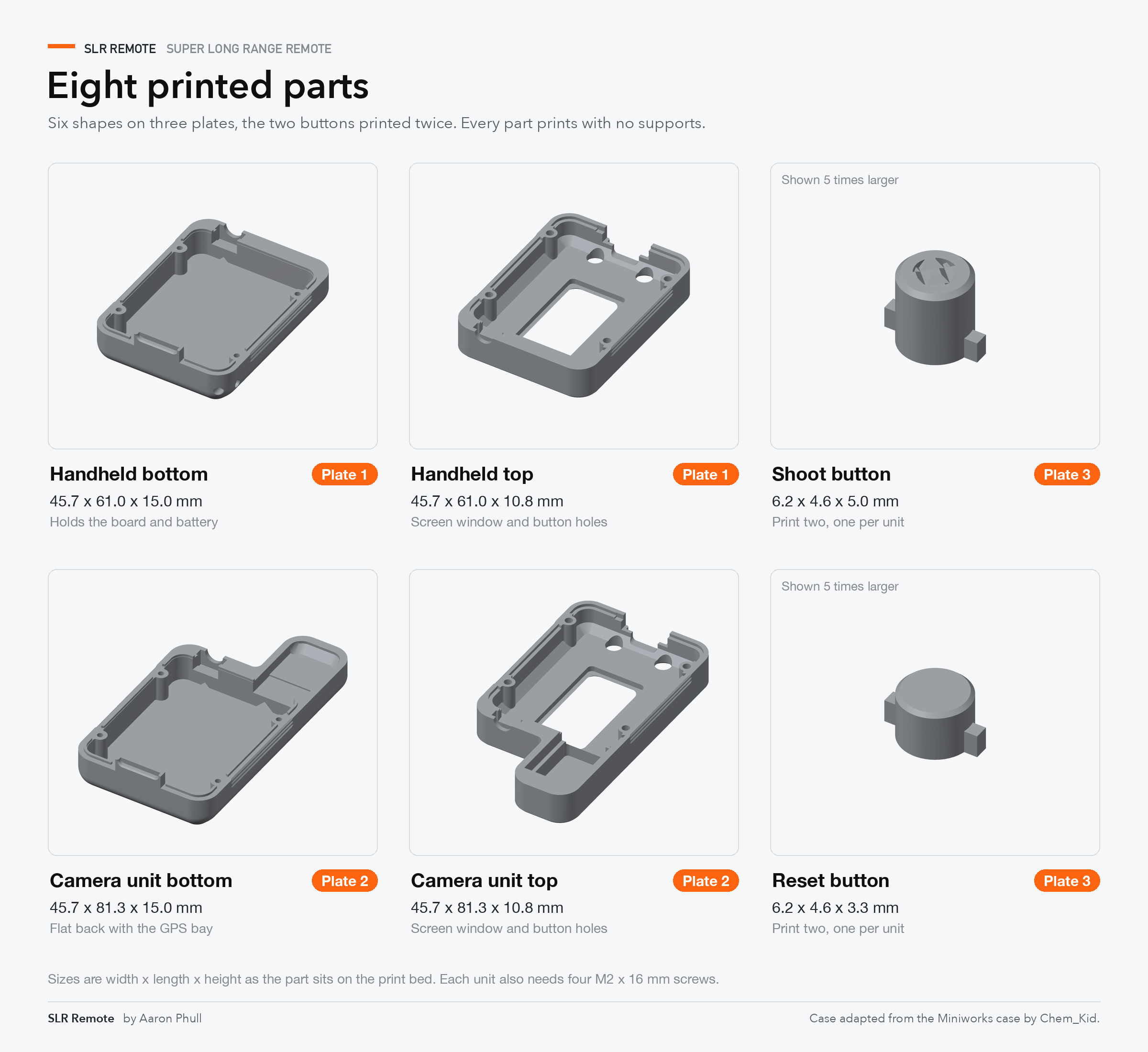
The handheld is 61 x 45.7 x 21.6 mm. The camera unit is a little longer at 81.3 mm, to make room for GPS. These are renders of the case design.
On a shoot
Where it earns its place in the bag
A few of the shoots I had in mind while building it.
The wildlife hide
Camera low by the feeder, you well back where the birds stop caring. Lock focus on the perch with a tap, then tap again the moment something lands. The handheld sleeps in your pocket between visits and wakes on the press.
The group shot you are actually in
Tripod up, walk over, stand with everyone else. Fire it from your hand behind your back, or set the self timer and put the remote away. With the tally light fitted, the whole group sees the moment it goes.
The long exposure
Nobody wants to touch a camera in the middle of a two minute exposure. With the remote talking straight to the camera, open the shutter on bulb and watch the clock count up on its screen. It closes at the time you set, or sooner if you press.
The landscape with you in it
Frame the valley, then walk into the frame. A long way into it. Hold the button to focus, let go to shoot, and watch PRESSED come back from across the field.
The time-lapse
Pick a gap and a frame count, hold to start, and leave it to run. The screen shows frames taken and seconds to the next one, and any press stops the run.
The camera you cannot stand next to
Clamped to a fence at a race, up a tree, by the goal. Start and stop video with a press, or take stills, from wherever you can stand.
Specs
For the technically curious
| Camera | Fujifilm X and GFX cameras with Bluetooth, through the standard Fujifilm remote release. Built and tested on the X-E5 |
|---|---|
| Shooting | Single shot, half-press focus hold, focus lock, self timer, interval, burst, bulb, video start and stop. Burst and bulb run in direct mode |
| Long range link | LoRa, spreading factor 7 to 12 chosen automatically, on the band you pick with the Region setting |
| Region EU 868 | UK and EU. 869.525 MHz, 125 kHz bandwidth, at up to the band's legal power limit |
| Region US 915 | United States. 918.0 MHz, 500 kHz bandwidth, about 25 dBm into the antenna. Built to the US rules, not yet tested on air |
| Reach | Built to work for miles with a clear view. Shrugs off walls, hedges and car doors |
| Response, fast setting | About 180 to 225 ms from the handheld sending to the camera unit accepting the press, then about 140 ms for each Bluetooth command to the camera (bench measurements) |
| Airtime | On EU 868, keeps itself to 10% of any rolling hour, counted on each unit and remembered across restarts. No airtime limit on US 915 |
| Security | X25519 key exchange with a six-digit code check at pairing. Every message carries an HMAC-SHA256 signature and a counter, so a recorded press cannot be replayed |
| Boards | 2 x Heltec WiFi LoRa 32 V4 (ESP32-S3, SX1262 LoRa radio, 0.96 inch OLED). The same firmware runs on both |
| Power | One LiPo cell in each unit (an LP603449 fits the case). The handheld sleeps after 60 seconds idle and wakes on a press |
| Antenna | 868 MHz in the UK and EU, 915 MHz in the US, on an SMA connector |
| Options | Quectel L76K GPS module, tally LED |
| Handheld | 61 x 45.7 x 21.6 mm without antenna, with a lanyard hole set into the corner |
| Camera unit | 81.3 x 45.7 x 21.6 mm without antenna, flat backed, with a GPS bay |
| Case | Eight printed pieces for the pair, no supports needed, four M2 x 16 mm screws per unit |
| Firmware | 0.4.0. Open source, MIT licence |
The walk test is written up in range, and how the remote grew over one week in November is in the design story.
Build one
From a bag of parts to your first frame
You need a 3D printer (or a friend with one) and a computer for loading the firmware. There is only a little wiring.
-
Get the parts
Two Heltec WiFi LoRa 32 V4 boards, two LiPo cells, two antennas for your band (868 MHz in the UK and EU, 915 MHz in the US) and eight M2 x 16 mm screws. The GPS module and tally LED are optional. Everything is on the shopping list.
-
Print the case
Three plates: handheld, camera unit, buttons. No supports. Sliced at 0.20 mm layers in PETG, the estimate for the whole set is about an hour and three quarters.
-
Put it together
Fit the antenna first, always: the radio should never transmit without one. Then the battery, board and buttons go in and four screws close each unit. The build guide takes you through it. Read safety and legal before you transmit.
-
Load the firmware
The same firmware goes on both boards. With PlatformIO installed, from the
firmwarefolder:pio run -e heltec_v4 -t upload -
Choose roles, set your region and pair
Set one board to
Handheldwith modeRelay, the other toCamera. SetRegionon both toEU 868orUS 915, whichever is yours. ChoosePair boardson both, check the six-digit code matches, and hold the button on each to say yes. Then choosePair cameraon the camera unit with the camera in Bluetooth pairing registration (that is the X-E5 menu name; other Fujifilm bodies are very similar). Step by step in flashing and pairing. -
Walk away and shoot
When the handheld says
READY, tap the button. Then see how far you can get.
FAQ
Questions you might have
How far does it really reach?
Far beyond any Bluetooth or infrared remote. It uses LoRa at full strength for its band, the same kind of radio used for links of several miles in open country. The one distance I have measured so far is a tough one: about 90 metres with no line of sight, the camera unit inside a parked car, small stock antennas, and it was still firing at the far point of the walk. The open-country test is next.
Can I use it in the United States?
Yes. It is the same board and the same firmware: fit 915 MHz antennas and set Region to US 915 on both units. That setting is built to the US rules but has not been tested on air yet, because I am in the UK and cannot legally transmit on 915 MHz here. If you try it, tell me how it goes. More in safety and legal.
Do I need my phone?
No. There is no app. Everything, including setup and pairing, is done with the button and the little screen on each unit.
Can it do video?
Yes. Put the camera in movie mode and a press starts recording; another press stops it. In a stills mode the same press takes a photo.
How do I know it took the picture?
The handheld shows PRESSED when the camera has accepted the press, and the optional tally LED on the camera unit lights as the shutter goes. The camera does not report on the photo itself, so if focus is tricky, hold the button to focus before you shoot.
Will it work with my camera?
If it is a modern Fujifilm with Bluetooth, very likely yes. The remote uses Fujifilm's standard Bluetooth remote release, the same one the camera's phone app uses, and most modern X and GFX bodies share it. Mine is an X-E5, and that is the camera I built and tested it on. Give yours a go and tell me how it gets on.
Plenty more in the full FAQ, and help if something misbehaves in troubleshooting.